
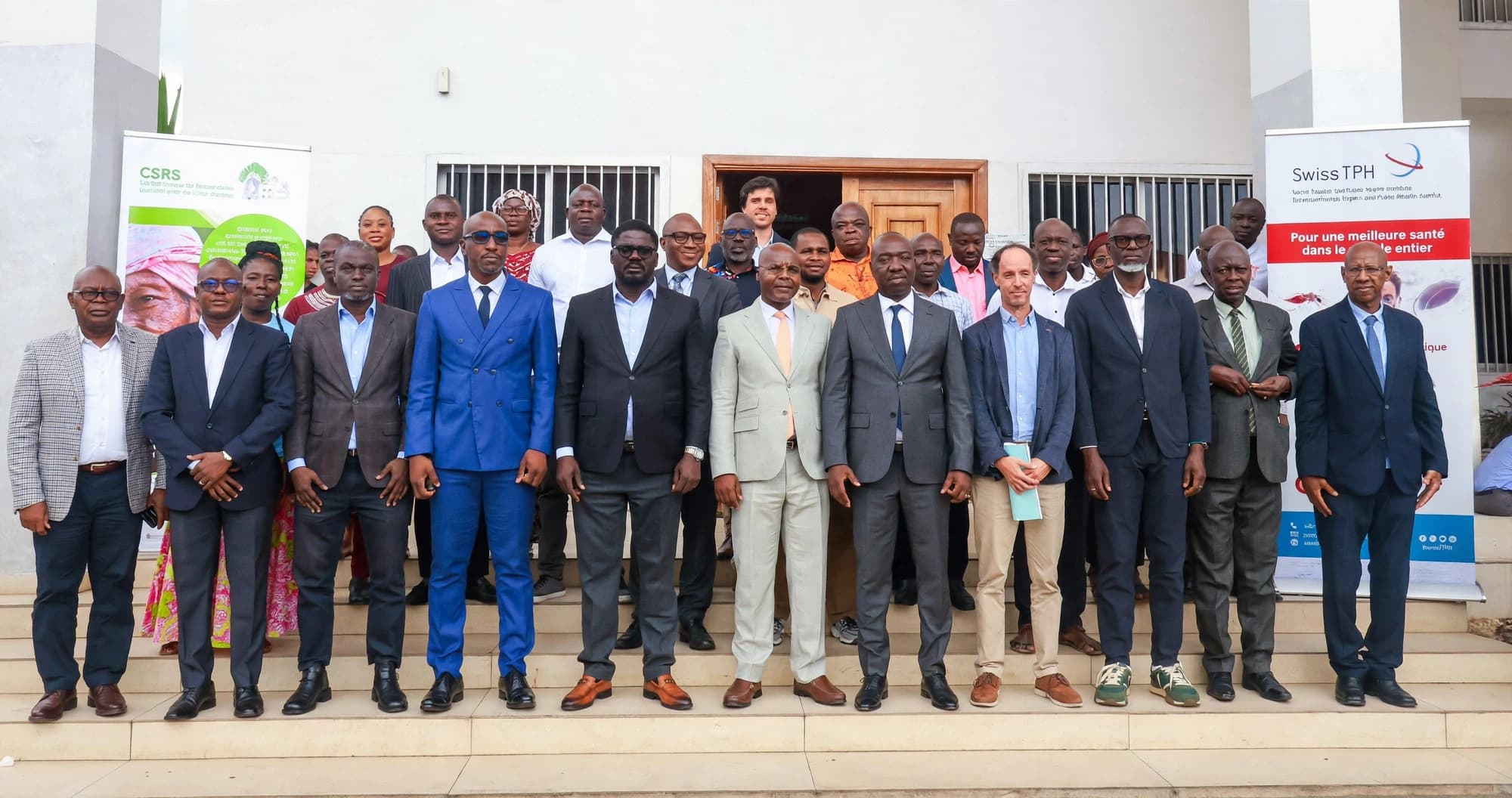
YopouLab Consortium – Towards an urban laboratory serving the community
First conceived in 2024 during a meeting between senior leaders of the Centre for Research in Social Sciences (Centre Suisse de Recherches Scientifiques en Côte d’Ivoire, CSRS) at the Swiss Tropical and Public Health Institute (Swiss TPH), the ‘YopouLab’ initiative has been taking shape since 2025, evolving into a transdisciplinary action research platform for urban public health based in Yopougon. Known as the Yopougon Urban Lab, or ‘YopouLab’, this initiative is based on close collaboration between the CSRS, Swiss TPH and the Yopougon Millionnaire-Extension Mixed Health Centre, bringing together researchers, public decision-makers and community leaders to address the public health challenges faced by rapidly expanding African cities such as Abidjan.
Following an initial survey carried out between April and May 2026 amongst 1,495 households in different types of housing in Yopougon, the initiative has entered a crucial phase of structuring and ensuring its long-term sustainability. Against this backdrop, the YopouLab consortium organised a two-day event focused on two strategic objectives. The workshop comprised two key and complementary sessions.
Monday 14 September (Norbert BEHI Room, CSRS) – Internal strategic alignment The first day brought together the CSRS Management Committee and the scientific teams from the CSRS and Swiss TPH who have been involved in YopouLab since its launch. Based on the survey results, this first day provided an opportunity to discuss the added value of YopouLab as a tool for collecting and analysing high-resolution data, as well as to outline various scenarios for a future Health, Demographic and Environmental Surveillance System (Health, Demographic, and Environmental Surveillance System: HDESS) based in Yopougon.
These discussions helped the team clarify the extent to which YopouLab could address both scientific and ‘practical’ challenges (that is to say, the concrete needs of stakeholders on the ground). These clarifications were essential to better guide the discussions on the second day of the workshop with non-academic stakeholders.
Wednesday 16 September (Wedding Hall, Yopougon Town Hall) – Local anchoring and institutional commitment The second day took place at Yopougon Town Hall, attended by the CSRS Executive Board, researchers from the CSRS and Swiss TPH, and representatives from the Autonomous District of Abidjan, the Ministries of Health, the Environment, Women and Children, the Order of Architects of Côte d’Ivoire, as well as various officials from Yopougon Town Hall. The main objective was to ascertain, using the April–May 2026 survey as an example, whether the tools and approach proposed by YopouLab generated practical interest amongst the aforementioned stakeholders, particularly with regard to the design and evaluation of public policies.
Consequently, this session was designed to be highly interactive. The approach based on urban form (health and well-being indicators observed by neighbourhood type, ‘precarious’, evolving and ‘formal/planned’) successfully captured the participants’ interest through its ability to identify health priorities specific to each neighbourhood or type of urban settlement.
These two days of workshops therefore marked a critical milestone in the dissemination of YopouLab, laying solid foundations for future cross-disciplinary exchanges. Indeed, by bridging the gap between scientific data and public policy (a research-action approach), YopouLab aims to provide a sustainable framework for public health and urban planning policies.
Follow this link to listen to the report produced by Radio Yopougon: https://www.csrs.ch/fr/videos
NGS/YopouLab Project Team/CelCom