The CAMPYLO project officially launched in Taabo
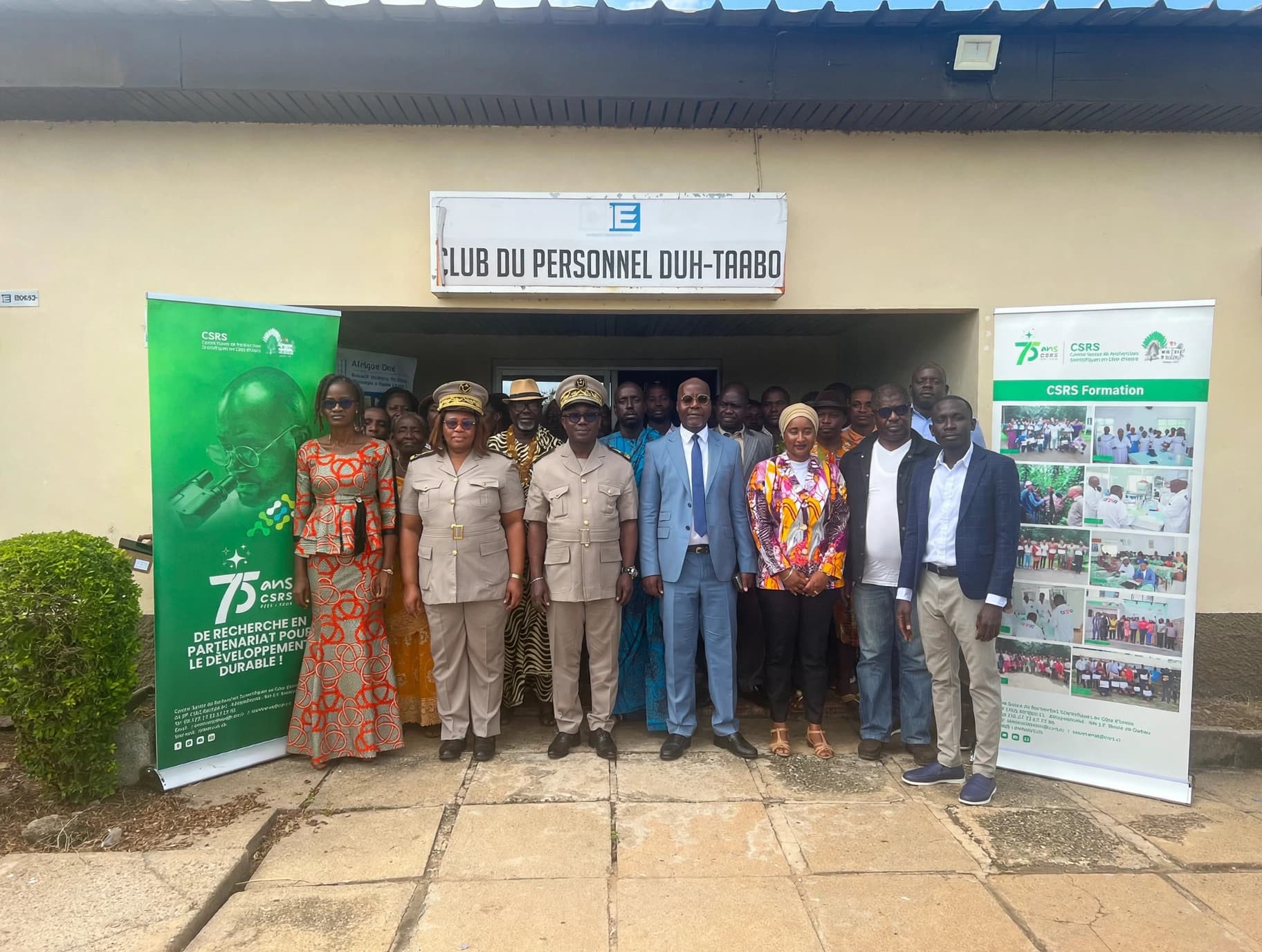
Taabo, 8 October 2026, The CIE Complex in Taabo (central Côte d’Ivoire) hosted the official launch ceremony for the CAMPYLO project, a research initiative aimed at gaining a better understanding of Campylobacter infections – a bacterium linked to diarrhoeal diseases, which are of particular concern among children under the age of five.
Funded by the Wellcome Trust through the University of Oxford and led by the Molecular Epidemiology Research Team (EREM) at the Centre Suisse de Recherches Scientifiques en Côte d’Ivoire (CSRS), the project aims to gain a better understanding of the mechanisms by which this bacterium is transmitted, with a view to helping prevent infections and protect children’s health.
A concerted effort by the authorities and local stakeholders
Chaired by the Prefect of the Taabo department, André Martin Kakou Brou, the ceremony was attended by around forty people, including administrative and local authority officials, health and veterinary officials, traditional leaders, representatives of women’s organisations and community health workers.
The opening addresses highlighted the importance of collaboration between research institutions, local authorities and communities in addressing public health challenges.
Speaking on behalf of the mayor of the municipality, the first deputy mayor, Kocoh Jocelyne Sandra, urged participants to pay particular attention to the work being carried out, expressing the hope that this initiative would make a tangible contribution to improving the health of the children of Taabo. In particular, she emphasised that ‘a healthy child means a happy family, which in turn leads to a prosperous nation’.
The Director-General of the Centre Suisse de Recherches Scientifiques en Côte d’Ivoire (CSRS), Professor Jérémie Zoueu, for his part, reaffirmed the CSRS’s commitment to promoting scientific research of the highest standard that is also of benefit to society. He emphasised the importance of action research, which involves addressing concrete problems, working with the relevant stakeholders and generating knowledge that can help improve people’s living conditions.
The Prefect of Taabo Department also called for active cooperation from technical services, community leaders, village chiefs and local residents to facilitate the work of the project teams.
Understanding diarrhoeal infections to better protect children
The presentation of the project, given by Dr Kanny Diallo, principal investigator and coordinator of CAMPYLO, enabled participants to learn about the scientific objectives of this initiative, its methodology and the main activities planned.
Infections caused by Campylobacter pose a public health concern due to their frequency and potential consequences. In children under the age of 5, repeated bouts of diarrhoea can contribute to malnutrition, stunted growth and developmental difficulties.
To gain a better understanding of these infections, the project adopts an integrated approach known as ‘One Health’ (One Health), which takes into account the links between human health, animal health and the environment. The research will, in particular, examine the various sources of exposure, the routes of transmission of the bacterium and the social and environmental factors likely to facilitate its spread.
The activities will take place in five villages in Taabo: Taabo Cité, Taabo Village, Ahondo, Kokoti-Kouamékro and Kotiéssou.
The community: a key partner in research
As well as the scientific presentation, the discussions with participants were a highlight of the launch. The questions and contributions from local stakeholders served to underline the importance of their involvement in the implementation of the activities.
This involvement is essential for promoting understanding of the project’s objectives, facilitating on-the-ground interventions and taking into account the realities faced by local communities.
By placing communities at the heart of its approach, CAMPYLO aims to make research a tool for public health and prevention.
The launch of the project thus marks the start of a collaboration between researchers, authorities, healthcare professionals and community stakeholders, all working towards a common goal: to gain a better understanding of infections caused by Campylobacter to help ensure the long-term protection of the health of children under five in Taabo.