
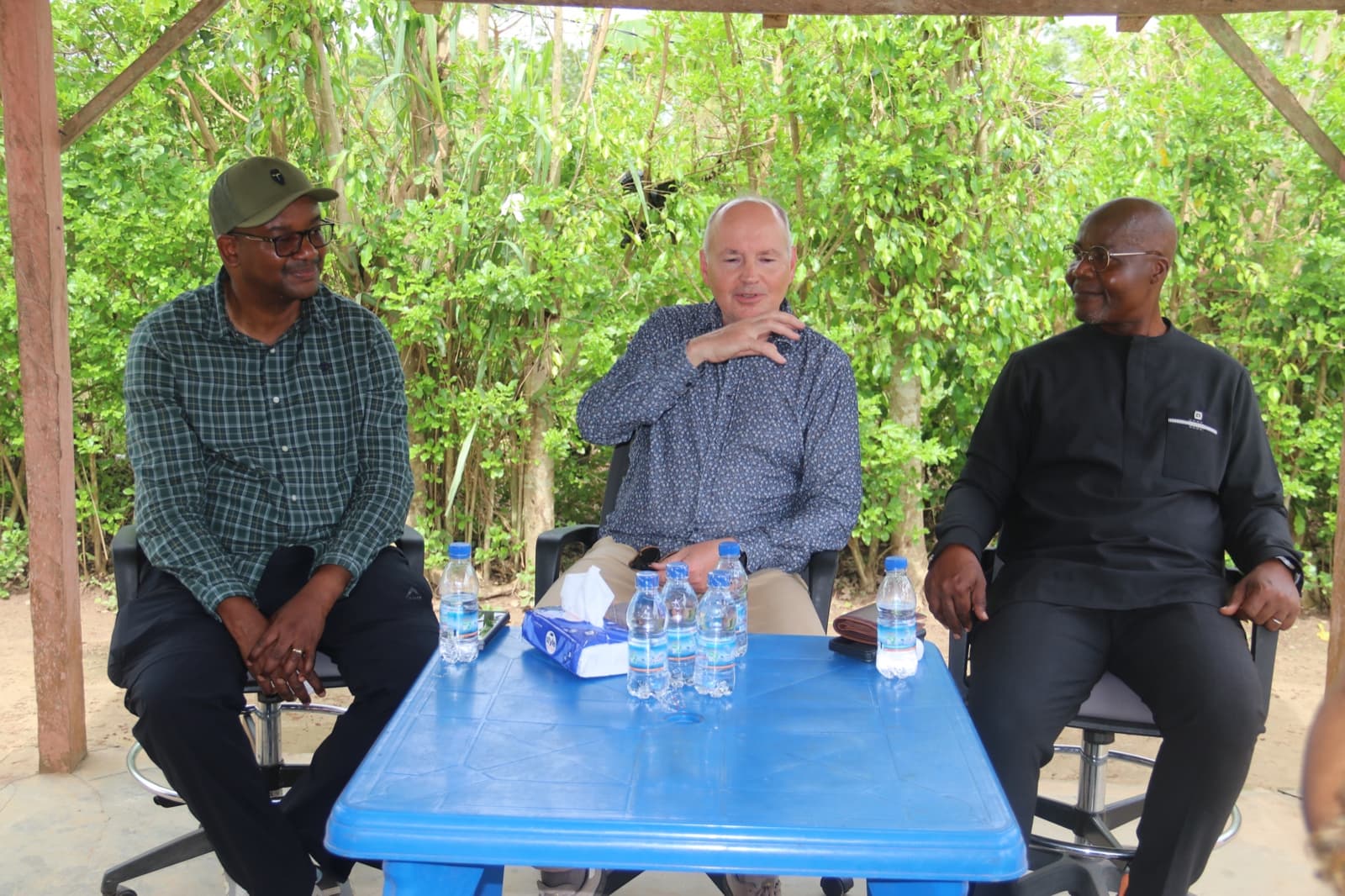
A day of immersion for Dr Jurg PFISTER and Prof Jeremie ZOUEU at the Tiassale research station
A day-long immersion programme was held at the Tiassale research station.
From left to right: Prof. Inza Koné, Dr Jürg PFISTER and Prof. Jérémie ZOUEU
On the occasion of his final Board of Directors meeting as Director-General of the CSRS and in the run-up to the forthcoming handover, Prof. Koné Inza led, on Sunday 14 June, a delegation comprising Dr Jürg Pfister, Secretary General of the Swiss Academy of Natural Sciences (SCNAT), and Professor Jérémie Zoueu, the Swiss Centre’s incoming Director General, on a visit to the Tiasssalé research station.
The field team, comprising researchers and laboratory technicians, gave the visitors a warm welcome, taking turns to explain with enthusiasm their day-to-day tasks involved in the trial process.
Located in the village of Tiassalé, the GLP (Good Laboratory Practice) experimental station was established in 2017 to carry out trials in Phases 1 (laboratory), 2 (semi-natural conditions) and 3 (at community level).
Accredited to Good Laboratory Practice standards since 2023, it comprises three sites, one of which is a research station featuring an insectarium for rearing mosquitoes, a laboratory for conducting efficacy and susceptibility tests on mosquitoes, a room dedicated to the observation and identification of mosquitoes following tests and collections in experimental huts, an animal facility, and a room used for the manual washing of mosquito nets. The other two sites comprise 41 experimental huts, 20 at the first site and 21 at the second. These huts are used to assess the effectiveness of vector control tools such as mosquito nets, insecticides, etc. whilst simulating natural conditions, and are situated directly opposite a rice field, which is conducive to the breeding of one of the world’s most resistant mosquito strains. This multi-resistant ‘Tiassalé strain’ has made this station one of the most sought-after in the world by industry players in the sector, who come here to assess the effectiveness of their products.
Tiassalé was the first stop on a tour of the CSRS’s thematic research sites in Côte d’Ivoire.
On Monday 15 June, the delegation, still led by Prof. Koné, visited the Bringakro station and finally the HDSS (Demographic and Health Surveillance System) site in Taabo.
Representing SCNAT on the Board of Directors, which was due to meet on Tuesday 16 June, Dr PFISTER showed particular interest in the research being carried out at the sites visited, which could lead to the development and strengthening of collaboration with this long-standing partner – a champion of international scientific cooperation which contributed to the creation of the CSRS 75 years ago.